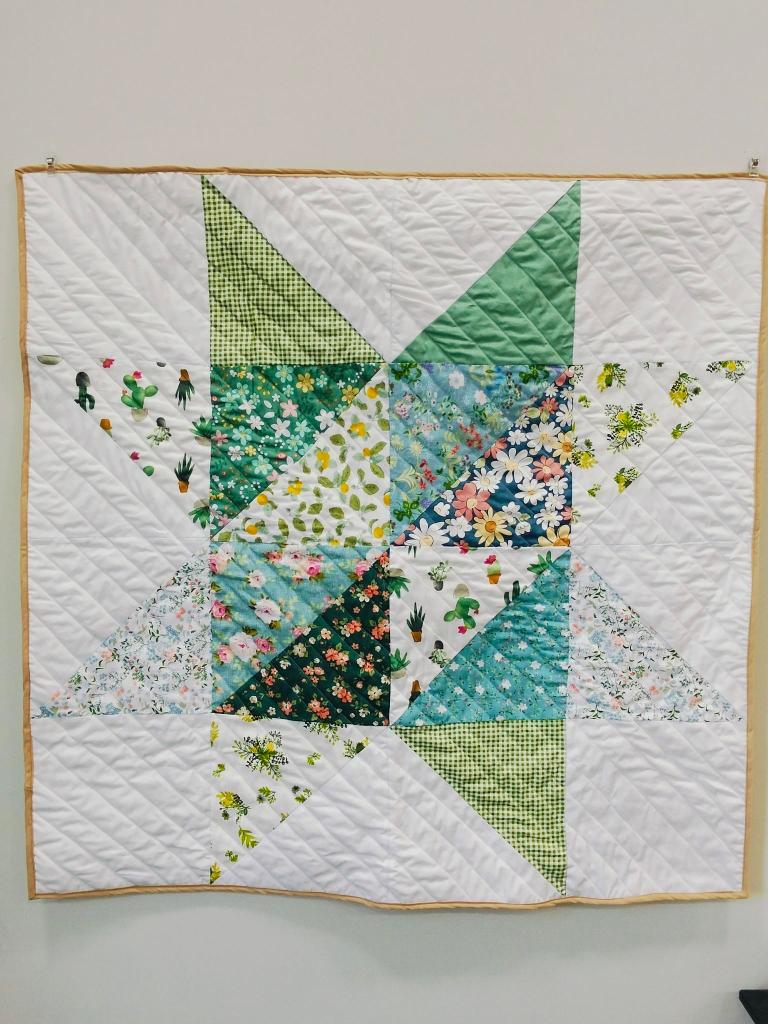
I still remember the quiet excitement of laying out those first teal and white batik squares on the table, unsure of what I was doing but certain that I wanted to make something real. I had seen so many intricate quilts before, but it was the simple elegance of diagonal lines and half-square triangles that finally convinced me to start. It felt approachable, almost like the quilt was whispering, “You can do this.”
The blues and greens, teal my favorite fabric color, stole my heart first. It was welcoming and vibrant, and paired with the crisp white batik, it felt clean and calm, a small promise of order in the middle of everyday chaos. I loved the way the different patterns in the star made every piece a little bit different—no two triangles exactly the same, each one unique.
Half-square triangles became my world for a while. I cut, sewed, pressed, and trimmed them until little teal-and-white stacks began to appear beside my machine. The diagonal seams felt like small acts of bravery. Measuring and stitching on the bias was intimidating, but there was something deeply satisfying about flipping open each unit to reveal a perfect (or almost perfect) triangle. Every time one came out even close to right, I felt that little spark of pride.
Of course, the quilt is far from perfect. Some of the points don’t match. A few seams wander off course, and if you follow the diagonals long enough, you’ll see where I tugged or stretched or simply misjudged. There were moments when I wanted to unpick everything and start again, to chase some impossible standard I had in my head. But this quilt gently taught me that finished is its own kind of beauty. That the story sewn into the fabric matters more than flawless alignment.
When I finally joined the rows and watched those diagonal lines appear across the top, I felt a rush that was almost physical. The teal and white pieces, once just piles of hopeful fabric, had turned into something whole. The quilt top wasn’t just fabric anymore; it was proof that I could carry an idea all the way from the first cut to the last stitch. It sounds simple, but in that moment it felt huge.
Quilting it was another adventure. I didn’t know all the rules, and I’m sure I broke more than a few. My stitches are not even, and some corners bunch in a way I didn’t plan. But as the layers came together, I realized I was layering more than batting between the top and the backing. I was stitching in evenings when I chose to make something instead of scrolling on my phone, quiet mornings spent pressing seams and listening to the hum of the iron, small moments of courage when I dared to keep going despite my doubts.
The day I bound the quilt, I ran my hands along the edges again and again, tracing the path of those diagonal lines. They crisscross in smooth, steady paths and occasionally stumble where I did. I stood back and looked at the blue and green colors with the white batik dancing together—cool, calm, and vibrant all at once. I felt something inside me loosen. I had made this. Imperfect, yes. But undeniably mine.
Now it hangs on the wall, a daily reminder that beginnings don’t have to be flawless to be meaningful. The colors have become part of the room, but somehow I still see that first spark of courage every time I glance at it. I see the late nights, the learning curves, and the decision to keep going when it would have been easier to tuck the pieces away in a drawer and call it a failed experiment.
When I look at that quilt, I don’t see the crooked seams first anymore. I see a journey. I see diagonal lines that carried me from “I don’t know if I can” to “I did.” I see half-square triangles that taught me patience and persistence. I see blue and green fabric and white batik that turned into a quiet, beautiful reminder that sometimes the most important thing we can do is simply finish what we start.


Leave a comment